Start of main content.

React, Headless, and Go

There's more than one way to build a website. 

Alongside our Drupal work, our senior team builds React applications, headless architectures and Go-based infrastructure for organisations that need flexibility, performance and long-term ownership of their platforms.

Talk to our team

Desktop/Illustration/React

What is React, headless and Go development?

These are three connected technologies we use to build modern digital platforms beyond a traditional CMS-only setup.

React is a widely adopted JavaScript library for building user interfaces. Its component-based architecture makes frontends fast, interactive and easier to maintain over time. We use React to build everything from individual interactive components inside a Drupal site through to fully decoupled applications.

Headless architecture separates the frontend (what users see) from the backend (where content is managed). Content is delivered through an API, which means the same backend can power a website, a mobile app, a kiosk or any other channel. This gives content teams flexibility and lets developers pick the best tool for each layer.

Go is a programming language built for performance and reliability. We use it to build the infrastructure that sits behind modern platforms. This includes APIs, custom services, Kubernetes tooling and the systems that keep large sites running at scale.

Our React, Headless and Go process

Every engagement starts with the problem, not the technology. We pick the right tool for what you're trying to achieve, rather than fitting your needs to a fixed stack.

  • Discovery and architecture. We work with your team to understand the platform's purpose, audiences, content model and integration points. We then recommend an architecture, which might be Drupal-led, headless, decoupled, or a mix.
  • Design system and components. For React work, we build reusable components grounded in a design system. We're equally comfortable working with Twig, Pinto and Storybook, which means React components can coexist with Drupal-rendered templates where that makes sense.
  • API and backend design. For headless and Go projects, we design clear, documented APIs. Our Go work spans gRPC, Huma, custom HTTP servers and Kubernetes-native systems built using Kubebuilder.
  • Build, test and review. Senior developers write and review every line. Our automated testing and quality controls apply across React, Go and infrastructure code. At every step, we apply the same standards we hold for Drupal.
  • Deployment and support. We deploy through repeatable pipelines, often using our Skpr hosting platform and in-house Terraform modules. After a project ends, most clients choose a BAU engagement model for continuous support. 
NSW Government Department of Customer Service logo with coastal background
NSW Government

The OneCX Program

Using the Digital NSW Design System as a foundation, NSW Government sites are consolidating onto nsw.gov.au to create a consistent user experience. Applying custom development, we have developed multiple features under the OneCX banner as part of this amalgamation. 

National mental health commission logo
National Mental Health Commission

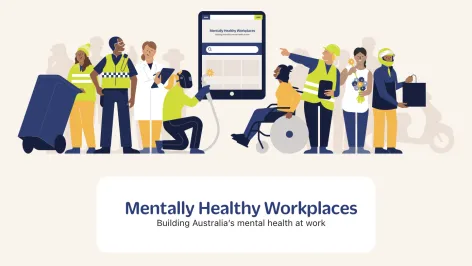
The Mentally Healthy Workplaces Platform

The award-winning Mentally Healthy Workplaces platform was our inaugural Drupal 10 project. The result is a site that provides a single credible avenue to contributed and curated information, resources and learning facilitated by lightning-fast natural language search. It enables and informs, encouraging organisations and individuals to create a mentally healthy workplace utilising trusted information. 

Desktop/Illustration/Headless

Why choose PreviousNext for React, headless and Go

We have the backend depth to design the API layer well and the operations maturity to run it reliably in production. Most agencies that run infrastructure don't write production frontend code. We do all three, with the same senior team.

Our developers average 16 years of experience and 10 years tenure at PreviousNext – five times the industry average. They're the same people who maintain Go-based Terraform providers, contribute to Drupal core, and build React components for government design systems. That means architecture decisions are made by people who have seen the positive outcomes of their work for a decade.

We're employee-owned, Australian-based, and have a zero record of mid-project replacements, critical security breaches, or hosting outages. When you engage us for React, headless or Go work, you get the same team that runs Australia's only Top Tier Drupal Certified Partner agency.

Meet the team

Are you ready to get in touch?

Contact PreviousNext

How we use React, headless and Go for our clients

Government

Government digital teams often need to deliver consistent experiences across multiple sites, channels and design systems. They also still need to meet accessibility, security and sovereignty requirements.

We've built decoupled React components using the NSW Government Design System for the OneCX program, and supported Service NSW's digital growth over many years. Our Go expertise underpins the Skpr hosting platform that runs critical government workloads, including high-profile sites that have withstood denial-of-service attacks without downtime.

Higher education

Universities run some of the most complex digital estates in Australia. We’re talking about multiple faculties, research centres, course catalogues, student-facing portals and marketing sites. Often, they have separate design systems sitting behind a shared brand.

React lets us build reusable interface components that work consistently across this estate. Headless architecture allows a single content source to feed websites, intranets, mobile apps, and learning platforms. We've worked with university clients on design system integration, sidebar navigation, faceted search interfaces and decoupled frontends. This work balances the autonomy that schools and faculties need with the consistency that marketing teams look for.

Enterprise

Enterprise platforms often need to integrate with existing systems. This includes CRMs, ERPs, search platforms, data warehouses and identity providers. They also need to perform reliably at scale.

This is where headless and Go come into their own. We build APIs and microservices that connect platforms cleanly. Custom Go-based services handle everything from search proxying to redirect engines to custom Lambda functions. On the frontend, React applications give marketing and product teams the interactive, app-like experiences modern audiences expect. All without locking the business into a proprietary frontend product.

Frequently asked questions

Do I need to use Drupal to work with PreviousNext on React or headless projects?

No. While Drupal is our foundation, we work with headless CMS platforms. These include Storyblok, Contentful and Sanity. We also build React frontends against a range of backends. That said, if content management is in scope, our Drupal experience often makes a Drupal-backed headless setup the most cost-effective option.

When does a headless architecture make sense - and when doesn't it?

Headless is a strong fit when:

  • You need to deliver content across multiple channels
  • Your frontend needs are highly interactive
  • Separate teams own the frontend and backend

It's usually overkill for a standard marketing website with a single channel. In that scenario, a traditional Drupal build will be faster to deliver and easier to maintain. 

We'll tell you honestly which approach fits your situation.

What do you specifically use Go for?

We use Go to build the infrastructure and tooling that sits behind modern platforms. Examples include: 

  • APIs and microservices
  • Kubernetes operators (built with Kubebuilder)
  • Custom AWS Lambda functions
  • Terraform providers
  • Redirect engines
  • Secure proxy layers between React frontends and search platforms such as OpenSearch

Much of this work powers our Skpr hosting platform.

How do you handle accessibility in React applications?

The same way we handle it in Drupal builds – as a core requirement, not an afterthought. 

Our React components are built to meet WCAG 2.2 AA. They are tested with assistive technology and reviewed against the same accessibility standards we apply across the rest of our work. For government clients, this includes alignment with the Digital Service Standard.

Can you work alongside an existing in-house team or another agency?

Yes. We often work as part of multi-vendor arrangements, particularly on government projects, where design, content strategy, and development are handled by different partners. Our process is built around clear documentation, code review and handover, so other teams can pick up our work without depending on us long-term (unless they’d like to!).